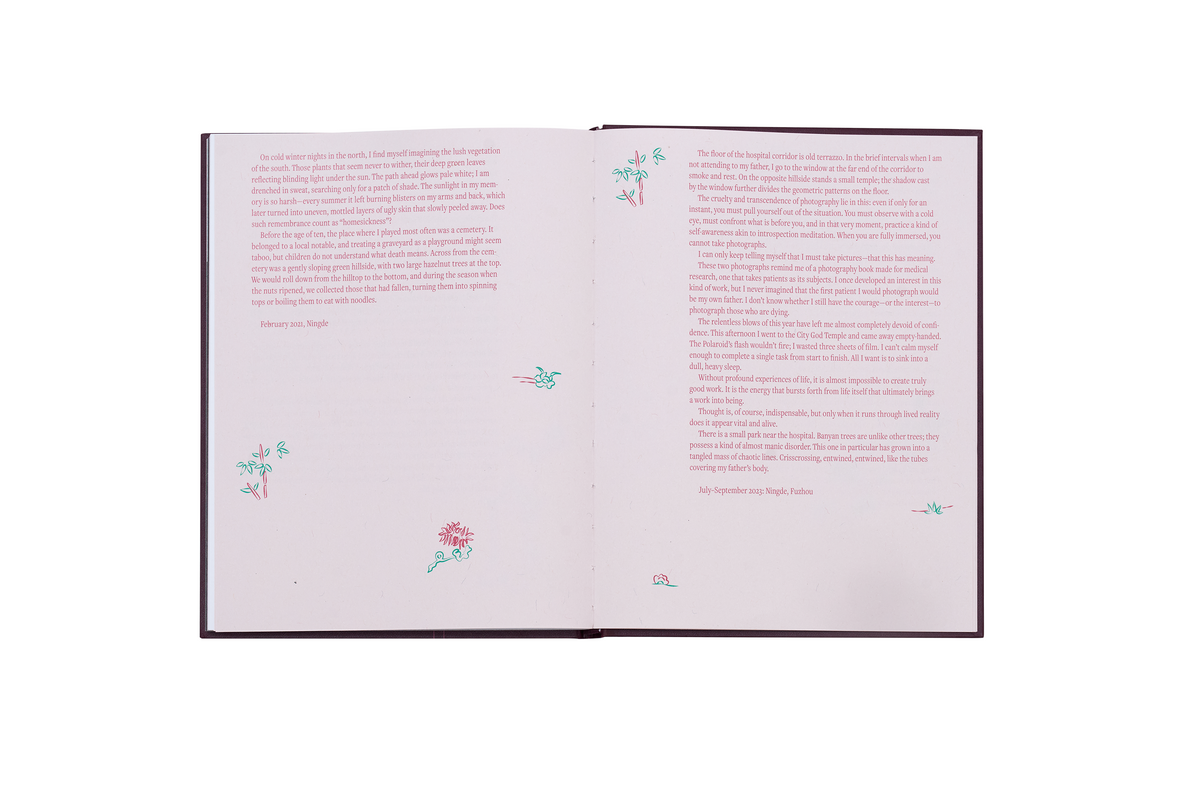
In 2020, I returned to my hometown of Ningde, Fujian, to take photographs. After years away, I had always wanted to escape this place. But when life took an unexpected turn, I found myself drawn back.
The color photographs document local folk beliefs and everyday life, while the black-and-white images capture the final stage of my father's life. Local traditions, in which humans and gods coexist, became intertwined with my personal experience of life and death.
Folk beliefs are deeply woven into everyday life in Fujian. In Ningde, people worship a monkey deity; in Zherong, they worship the goddess Ma Xian, who often manifests as a toad. There are also Mazu, Guan Yu, Nezha, and the Dragon King. Each jing, a local territorial community, has its own temple and guardian deity, much like the Earth God who watches over a particular area.
During the pandemic, all processions of the gods were canceled, and temples remained closed. I visited more than a dozen temples across different jing, but their architecture and layouts were so similar that I began to grow tired of photographing them. I almost ran out of things to photograph. Yet there was always a way in, if you knew where to look. Even when large public ceremonies were impossible, the need to pray could not be shut away.
The book's title, Ouroboros, refers to a cycle: the moment I press the shutter, everything has already become the past. But when I look back at the photographs, that past returns to the present. Through these images, I came to understand anew how my hometown had shaped me, and in doing so, gained a new understanding of myself.